From Uniform to Statement: The New Life of the Shirt

by Alice Colino

Every time Fashion Week draws to a close, the guessing game begins over what the season's hero piece will be. Following the Milan shows in September—those dedicated to Spring/Summer 2027—the answer I arrived at is perhaps the least sensational possible: the shirt.


It was everywhere: styled under suits and layered over dresses, tied at the waist, left wide open, or worn with one button too many left undone. The reality is that talking about distinct seasons makes less and less sense, and the shirt proves this better than any other garment. Rather than a passing trend, it is an enduring constant that reinvents itself each time. It makes you wonder how something so fundamentally simple—essentially two sleeves, a collar, and a row of buttons—can feel completely new every single season.

The Shirt: From Undergarment to Uniform

To understand this, we have to look back to when the shirt was not even visible. For centuries, it served as an undergarment—a layer of linen or cotton worn directly against the skin, concealed under jackets and bodices. Showing it was considered unrefined, much like exposing one's underwear would have been.


Over time, it was the collar—white, rigid, and starched—that emerged as a badge of social standing. It distinguished office workers whose hands remained clean, giving rise to the phrase "white-collar" that we still use today.

It was, of course, a man’s world. Women adopted it towards the end of the nineteenth century in the form of the blouse, paired with a long skirt by the earliest female clerks and shop assistants who required practical, neat attire for work. From there, stepping into the male wardrobe was a short leap, and throughout the twentieth century, men's shirts found their way onto women with increasing regularity.


In the 1980s, power dressing placed it beneath broad-shouldered tailored suits, while 1990s minimalism stripped it back to its bare essentials. It was then that the white shirt became a quasi-uniform: buttoned up to the neck, meticulously pressed, invariable, and cut to proportions designed for male bodies even when worn by women.

The Shirt on the 2026 Runways

On this year's runways, that once-regimented shirt appeared decidedly liberated. Several collections placed the spotlight on colour, pairing pink, powder blue, and white shirts within the very same ensemble, cut with clean, almost austere lines that let the shades do the work. Others took a more romantic path filled with pussy bows, corolla collars, and sheer textures, using chiffon, lace, and organza to make shirts feel light and ethereal.


Then came the deconstructed white shirt, perhaps the most compelling direction of all. It calls to mind the legacy of Italian fashion designers who approached the shirt as an architectural project, calibrating every fold down to the millimetre. Today, that exacting precision is turned on its head: volumes are shifted, collars open asymmetrically, and buttons intentionally bypass their buttonholes. The outcome appears effortless, yet rests upon a deliberate idea of imperfection.

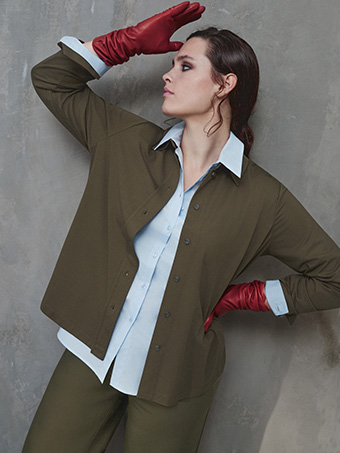
Viewed this way, the shift from past to present is striking. Yesterday’s shirt was worn alone, buttoned up, and ordered by masculine conventions. Today’s shirt is worn open, slightly askew, and has become the starting point for layering for women and men alike.


This shift carries implications beyond aesthetics: for decades, the shirt was an exacting garment defined by a strict fit and a prescribed way to wear it; anyone who did not fit those rules felt as though they were wearing something borrowed. The moment perfection is no longer required, the shirt begins to adapt to the wearer—a freedom that seemed out of reach not long ago.

Outfit Ideas with Shirts

Translating this runway spirit into daily life is simpler than it seems. An oversized lilac shirt with a neck bow, for instance, instantly draws focus towards the face while creating soft drape that complements the silhouette without clinging. It works beautifully left untucked over straight-leg trousers or a midi skirt, keeping the bow loosely tied rather than tightly done up.


For a relaxed office look, try tone-on-tone styling with a classic white shirt worn unbuttoned like a light jacket over a grey ensemble composed of a tunic top and wide-leg trousers. The unbroken vertical line of grey from shoulder to hem creates an elongated, refined effect.

Under a tailored blazer dress, simply let the collar and cuffs peek through—perhaps turning the cuffs back over the jacket sleeves—for a polished yet relaxed feel. Paired with a grey trouser suit, a black shirt with scarf detail takes the place traditionally held by a necktie in menswear, lending individuality to classic tailoring.


A few styling touches work across the board: tucking only the front hem into trousers to define the waistline without restricting it,

rolling sleeves to mid-forearm, and opting for fluid fabrics that move naturally with the body.


Most of us have a go-to shirt—the one reached for whenever inspiration runs short, knowing it coordinates with everything. Over the years it has changed meaning many times without losing its essential form; perhaps the reason it never dates is its enduring ability to leave room for the person wearing it.